
 |
|
|
|
|
|
|
|
|
|
|
|
|
|
|
|
 |
 |
 |
 |
 |
 |
 |
 |
 |
 |
 |
 |
 |
 |
 |
|

Listed Canadian Artist: (1877-1954)
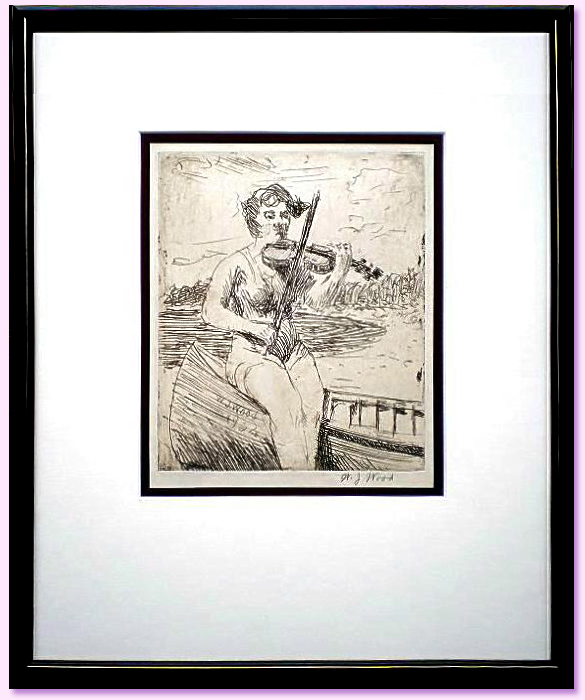
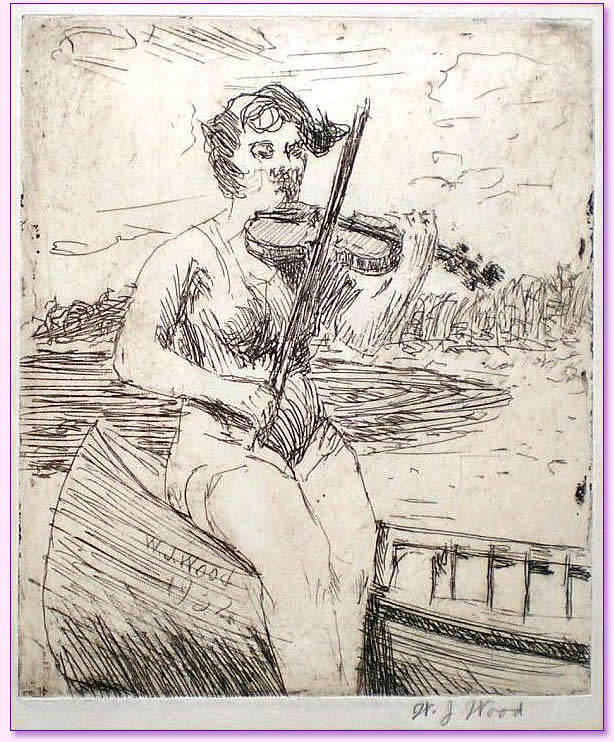
Drypoint Etching: young girl sitting on canoe playing violin.
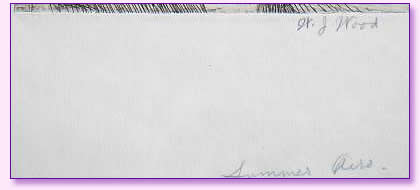
Signed: On the plate and dated 1932 and in pencil on the margin.
Titled: " Summer Airs" under mat, see photo below.
Image Size: w. 6" by h. 7".
Condition: pristine with no issues.
Framed: Archivally matted with acid-free materials throughtout.

A Note of Interest: William Wood often incorporated the people, settings and occasions around him in many of his paintings, drawings and etchings. So it is beleived that the violinist model he etched here was actually his wife.
William John Wood CGP, CSGA, CPE

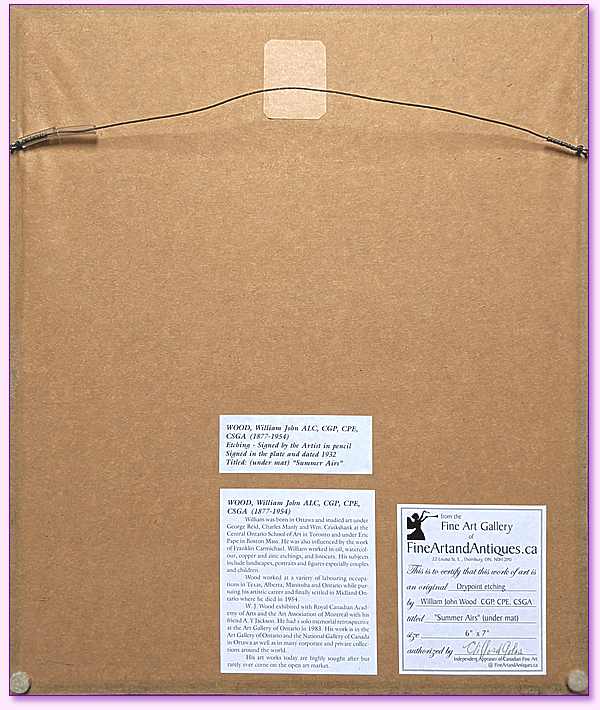




 William was born in Ottawa and studied art under George Reid, Charles Manly and Wm. Cruikshank at the Central Ontario School of Art in Toronto and under Eric Pape in Boston Mass. He was also influenced by the work of Franklin Carmichael and other 'Group of Seven' members. William worked in oils, watercolours, and created copper and zinc plate etchings, and linocuts. His subjects include landscapes, portraits and figures especially couples and children.
W.J. Wood worked at a variety of labouring occupations in places like, Texas, Alberta, Manitoba and Ontario while still pursuing his artistic career and then finally settled in Midland Ontario.
Wood exhibited with Royal Canadian Academy of Arts and the Art Association of Montreal along with his friend A. Y Jackson. He had a successful solo memorial retrospective at the Art Gallery of Ontario in 1983. His works are in the collection of the Art Gallery of Ontario and the National Gallery of Canada in Ottawa as well as in many corporate and private collections around the world.
W. J. Wood was a close friend of Arthur Lismer, one of the founding members of the Group of Seven. Both artists shared a deep appreciation for the Georgian Bay landscape, and Lismer held Wood’s work in very high regard, even inviting him to join the Group. Through his close association with A.Y. Jackson, and with Jackson’s encouragement, it has often been considered that Wood might well have become a member of the Group of Seven—potentially making it the Group of Eight—had it not been for his responsibility to financially support his large family.
Wood’s paintings and prints display a quiet strength and sincerity, often capturing the rural and lakeside scenes of his native Midland area. His artworks today are highly sought after, yet they rarely come up for sale on the open art market, adding to their appeal and mystique among collectors and scholars of early 20th-century Canadian art.
Did you know, that William John Wood was often referred to by his contemporaries and friends as W. J., particularly in correspondence and exhibition records. Both Arthur Lismer and A.Y. Jackson referred to him that way in letters and exhibition notes. For example, Lismer’s writings and later references in the Ontario Society of Artists and Royal Canadian Academy listings used “W. J. Wood” consistently. So, while “William John Wood” is his full name (and what’s usually used in biographical contexts), “W. J. Wood” is the name most commonly used by his peers and in period documentation — similar to how other members of the 'Group', “A.Y. Jackson”, "A.J. Casson" or “J.E.H. MacDonald” were known.
William (W.J.) John Wood passed away in 1954.
Print Ref No: 4IEX10WEB-S/TTOEX
Copyright 2025 © FineArtandAntiques.ca

William John Wood CGP, Canadian Artist
Updated November 6, 2025 |
|
|---|
