
 |
|
|
|
|
|
|
|
|
|
|
|
|
|
|
|
 |
 |
 |
 |
 |
 |
 |
 |
 |
 |
 |
 |
 |
 |
 |
|

Listed Canadian Artist and Printmaker: 1879-1960
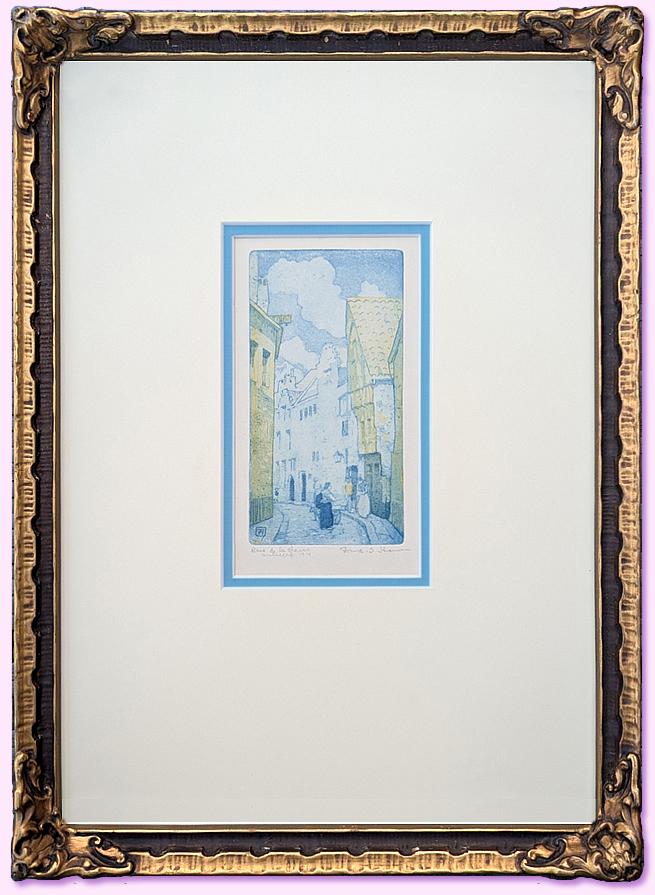
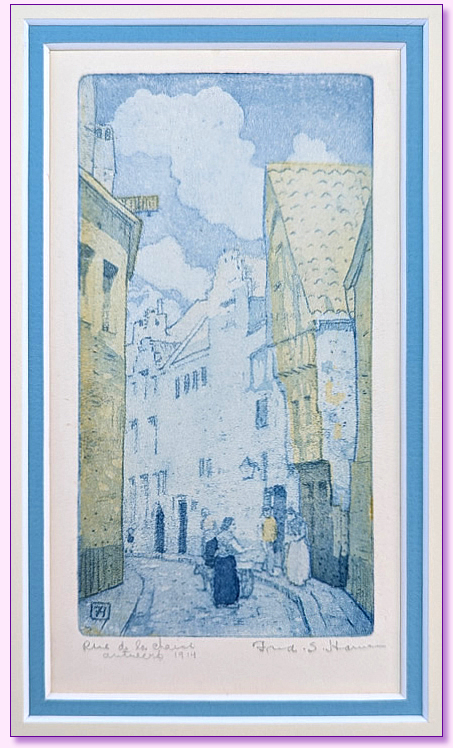
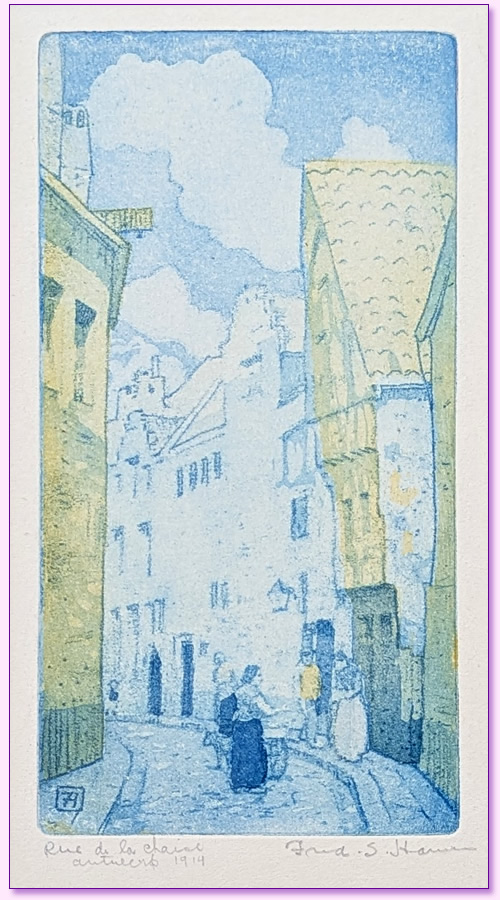
Titled: “Rue de la Chaise, Antwerp".
Edition Size: Unnumbered, Fred's early edition size was usually 30 prints.
Signed & Dated: Fred Haines dated 1914. Fred's 'chop' monogram lower left.
Image Size: w. 2.75 in. by h. 5.5 in.
Condition Note: Pristine with original colours, and without flaws.
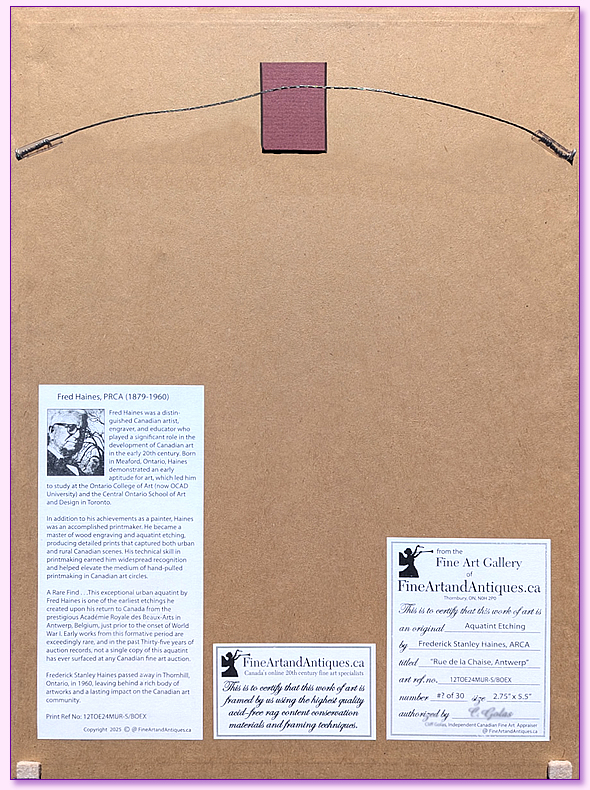
Archivally encased: with acid-free, rag content materials throughout.
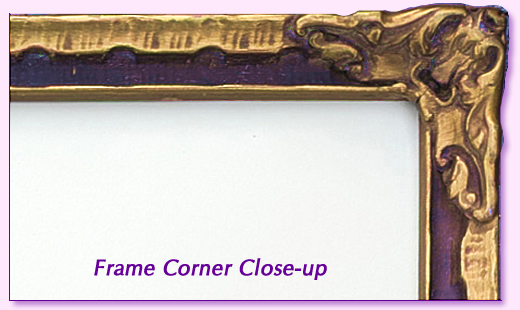
Frame: Magnificent vintage custom moulded composition frame ca.1920, in original fine condition, no restoration,

Note of Interest: A Rare and Historic Find...This exceptional aquatint by Fred is one of the earliest etchings he created upon his return to Canada from the prestigious Académie Royale des Beaux-Arts in Antwerp, Belgium—just before the onset of World War I. Early works from this formative period are exceedingly rare, and in over 35 years, not a single copy has surfaced at any fine art auction. This aquatint is not just another work of art by Fred—it’s a rare window into the beginnings of a master printmakers’s journey.
Many people may not know that Frederick Stanley Haines was a first cousin of Franklin Carmichael and that Fred encouraged Carmichael early on in his artistic career. Fred and Franklin were on an art education journey together in Europe which was cut short and they both returned to Canada just prior to the start of WW1. Franklin Carmichael went on to join the Group of Seven in April 1920, as the youngest of the founding members. The group was formally established in 1920 to portray Canada's rugged landscape, and Carmichael participated in their first art exhibition that same year.
Fred Haines, PRCA, OSA, Rue de la Chaise, Aquatint 1914
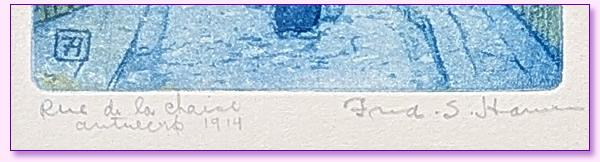


Fred Haines (1879–1960), a respected Canadian printmaker and painter, is well known for the refinement of his aquatint etchings. Among collectors and scholars, one distinctive feature often noted on Fred's prints is the presence of his personal 'chop' mark—a small, monogram created on-plate that he incorporated to authenticate his finished works. However, not all Haines etchings display this chop, leading to important questions about his studio practices and printmaking methods.
The absence of a chop on certain Haines prints can be attributed to several factors. First, artists frequently pull what are called "proofs" during the creative process—trial impressions used to assess the development of an image. Proofs were not intended for public sale and often remained unsigned and without a chop. If these proofs later entered the market, their missing chop mark may simply reflect their original experimental purpose.
Secondly, the use of a chop mark was not uniformly consistent throughout Haines's career. In his early work, particularly before the 1920s, he had not yet fully formalized the practice of marking prints with a chop, but did start its use as early as 1914 when he arived back in Canada with his cousin Franklin Carmichael before WWI. As his reputation grew, he increasingly incorporated the chop to verify and protect his finished editions.
There are also practical considerations. Occasionally, a limited run of prints, perhaps created for friends, patrons, or specific exhibitions, might have been signed only in pencil without the addition of the chop. Furthermore, technical factors such as the thickness of paper or the demands of exhibition deadlines could make incorporating his chop impractical. Fred may also have eliminated placing his 'chop' on a print because it may have conflicted with a darker background.
It's a known fact the Fred did make use of a separate 'chop' woodcut stamp that he used on prints after they had been pulled. This fact is evident, as these chop marks were usually stamped outside of the body of a print in a colour that was not used within the print irself, but stood outside the colour range used in that particluar aquatint.
Collectors encountering a Fred Haines print without a chop should consider the full context of the situation when the print was originally made. The lack of a chop mark does not diminish an aquatint etching's value or significance, but rather offers an insight into the living and working processes of an artist whose technical mastery and sensitivity to the Canadian landscape continue to resonate to this day.

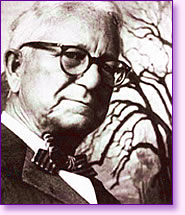 Fred Haines was a distinguished Canadian artist, engraver, and educator who played a significant role in the development of Canadian art in the early 20th century. Born in Meaford, Ontario, Haines demonstrated an early aptitude for art, which led him to study at the Ontario College of Art (now OCAD University) and the Central Ontario School of Art and Design in Toronto.
Haines' career spanned several disciplines, including painting, printmaking, and teaching. As a painter, he is best known for his landscapes, which often depicted the rugged beauty of the Canadian wilderness. His work reflected the influence of the Group of Seven, with whom he shared a passion for portraying Canada’s natural environment. However, Haines maintained a distinctive style characterized by refined detail and an emphasis on the interplay of light and shadow.
In addition to his achievements as a painter, Haines was an accomplished printmaker. He became a master of wood engraving and aquatint etching, producing detailed prints that captured both urban and rural Canadian scenes. His technical skill in printmaking earned him widespread recognition and helped elevate the medium of printmaking in Canadian art circles.
Haines was also deeply committed to arts education. He served as the Principal of the Ontario College of Art from 1932 to 1951, during which he significantly modernized the curriculum and championed the integration of traditional and contemporary art practices. Under his leadership, the college became a Canadian hub for artistic innovation and collaboration.
He is known to have studied at the prestigious Académie Royale des Beaux-Arts in Antwerp, Belgium.
His time in Europe exposed him to classical and contemporary European art traditions, which further influenced his artistic development. The European experience helped refine his technical skills, particularly in etching and engraving, and it broadened his appreciation for landscape and figure painting.
Haines returned to Canada in 1914 just before the outbreak of World War I, bringing with him the knowledge and techniques he had acquired abroad, which he integrated into his work and later shared with students during his tenure as an educator.
 Haines was a founding member of the Canadian Society of Painters in Water Colour and a longtime member of the Royal Canadian Academy of Arts, where he served as President from 1939 to 1945. His contributions to Canadian art were widely acknowledged during his lifetime, and his legacy continues to influence artists and educators today. His paintings and prints are held in numerous public and private collections across Canada, serving as a testament to his talent and dedication to Canadian art. Over the years, Fred remained close to his cousin Franklin Carmichael and this kinship was visually captured in a oil on panel by Fred, believed to have been painted circa the late 1930's.
Frederick Stanley Haines passed away in Thornhill, Ontario, in 1960, leaving behind a rich body of work and a lasting impact on the Canadian art community.
Print Ref No: 12TOE24MUR-S/UOEX

Fred Haines Aquatint 1914
Updated October 7, 2025 |
|
|---|
